Imagine leaving your home each morning wearing invisible armor — a shield around your heart, your family, your provision, and your peace of mind. That is exactly what the morning adhkar are: the daily remembrances taught by the Prophet Muhammad (peace be upon him), recited at dawn, that guard the believer until evening. These morning adhkar duas are not long or complicated. In ten quiet minutes, you can wrap your entire day in divine protection.
Many of us rush through our mornings — phone first, news first, worries first — and wonder why the day feels so heavy. The adhkar flip that order. They put Allah first, and everything else falls into its proper place. Here is a complete, practical guide to the authentic morning remembrances: what they are, the most powerful ones to recite, and how to build a routine you will actually keep.
What Are the Morning Adhkar?
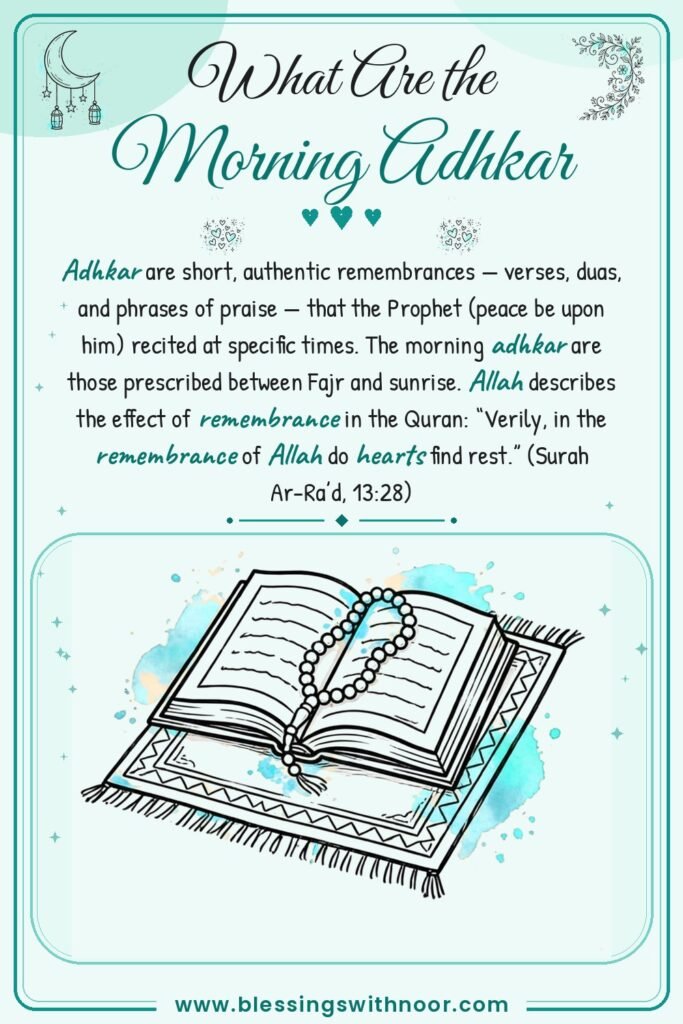
Adhkar (the plural of dhikr) are short, authentic remembrances — verses, duas, and phrases of praise — that the Prophet (peace be upon him) recited at specific times. The morning adhkar are those prescribed between Fajr and sunrise (and can be made up until mid-morning if missed). They are drawn from the Quran and the authentic Sunnah, and they serve three purposes: remembering Allah, seeking His protection, and asking for the day’s blessings.
Allah Himself describes the effect of remembrance in the Quran: “Verily, in the remembrance of Allah do hearts find rest.” (Surah Ar-Ra’d, 13:28). The adhkar are not magic words — they are a conversation. Each one turns your face toward Allah before the world turns it toward everything else.
The Core Morning Adhkar Duas: Your Daily Shield
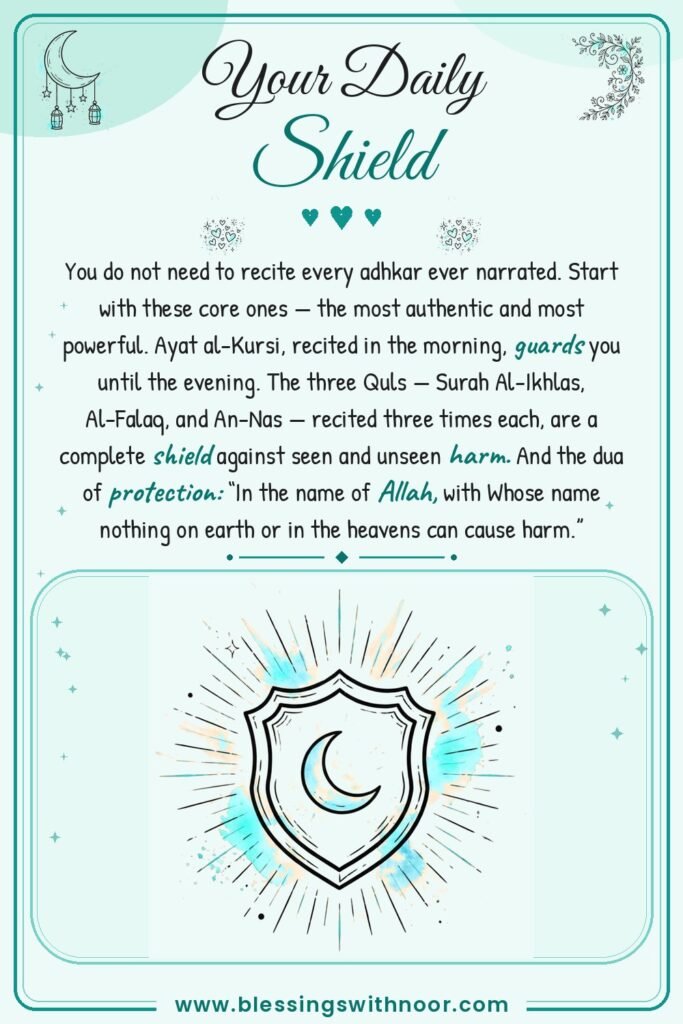
You do not need to recite every adhkar ever narrated. Start with these core ones — the most authentic and most powerful — and add more over time.
1. Ayat al-Kursi (once). The greatest verse of the Quran, recited in the morning, guards you until the evening. It declares Allah’s absolute sovereignty over the heavens and the earth — and nothing harmful can touch the one under His guard. Read about its power in our article on Ayat al-Kursi & Duas for Protection, and reflect on the verse itself at Surah Al-Baqarah, 2:255.
2. The three Quls (three times each). Surah Al-Ikhlas, Surah Al-Falaq, and Surah An-Nas — recited three times each in the morning — are a complete shield against seen and unseen harm. Surah Al-Falaq and An-Nas were specifically revealed as protection, and the Prophet (peace be upon him) never abandoned them.
3. The dua of protection from all harm (three times):
بِسْمِ اللَّهِ الَّذِي لَا يَضُرُّ مَعَ اسْمِهِ شَيْءٌ فِي الْأَرْضِ وَلَا فِي السَّمَاءِ وَهُوَ السَّمِيعُ الْعَلِيمُ
Bismillahilladhi la yadurru ma’asmihi shay’un fil-ardi wa la fis-sama’i, wa huwas-sami’ul-‘alim.
“In the name of Allah, with Whose name nothing on earth or in the heavens can cause harm, and He is the All-Hearing, the All-Knowing.” Recite this three times each morning, and no sudden calamity will befall you that day. Let that promise settle in: the One whose name you invoke is the All-Hearing — He hears your whisper — and the All-Knowing — He knows what you fear.
4. The dua of contentment (three times):
رَضِيتُ بِاللَّهِ رَبًّا، وَبِالْإِسْلَامِ دِينًا، وَبِمُحَمَّدٍ صَلَّى اللَّهُ عَلَيْهِ وَسَلَّمَ نَبِيًّا
Raditu billahi Rabba, wa bil-Islami deena, wa bi Muhammadin sallallahu ‘alayhi wa sallama nabiyya.
“I am pleased with Allah as my Lord, with Islam as my religion, and with Muhammad (peace be upon him) as my Prophet.” This is a declaration of identity. Before the world tells you who to be today, you tell yourself — and your Lord — who you already are: His servant, upon His deen, following His Messenger.
5. The morning dua of the Prophet (once):
اللَّهُمَّ بِكَ أَصْبَحْنَا، وَبِكَ أَمْسَيْنَا، وَبِكَ نَحْيَا، وَبِكَ نَمُوتُ، وَإِلَيْكَ النُّشُورُ
Allahumma bika asbahna, wa bika amsayna, wa bika nahya, wa bika namoot, wa ilaykan-nushoor.
“O Allah, by Your grace we have reached the morning, and by Your grace we reached the evening. By Your grace we live, and by Your grace we die, and to You is the resurrection.” This frames your whole day: you did not wake yourself up — He woke you. The day is His gift, and you will return it to Him filled with gratitude.
Why the Adhkar Protect You
Protection in Islam is not superstition — it is a relationship. When you recite the morning adhkar, three things happen. First, you remember Allah, and He remembers you — the divine exchange promised in the Quran. Second, you consciously place your trust in Him, which calms the anxious heart far more deeply than any worry ever could. Third, you align your day with the Sunnah, and there is barakah in following the Prophet’s footsteps that no planning can manufacture.
Think of the adhkar as locking your doors at night. You would never sleep with your front door wide open — so why walk into a day full of spiritual and worldly risks without your shield? The evil eye, sudden accidents, harmful whispers, your own bad decisions — the morning adhkar address them all, not by your strength, but by His.
A Practical 10-Minute Morning Routine
Here is a routine anyone can keep, even on busy mornings. Set a timer if it helps:
Minutes 1–2: Ayat al-Kursi, slowly, thinking about its meaning — Allah’s throne extending over all existence, guarding you within it.
Minutes 3–5: The three Quls, three times each. Let the rhythm calm your breathing.
Minutes 6–8: The duas above — the protection dua (3x), the contentment dua (3x), and the morning dua (1x). For the complete daily shield including the evening adhkar, see our guide to Morning & Evening Adhkar for Daily Protection.
Minutes 9–10: One hundred “SubhanAllahi wa bihamdih” (Glory be to Allah and praise Him) — or as many as you can. This single phrase wipes away sins even if they are like the foam of the sea, and it takes barely two minutes.
Do this after Fajr if you can — but if you miss the window, do it whenever you remember. A late shield is better than no shield. And explore more dawn practices in our Fajr Blessings article and the full Morning Prayers collection.
Teaching Adhkar to Your Family
The morning adhkar are a beautiful gift to pass on. Teach your children one dua at a time — start with the three Quls, which most children can memorize within weeks. Recite the protection dua together in the car on the way to school. Let them hear you saying your adhkar after Fajr; children absorb what they witness far more than what they are told.
For your spouse, share one new adhkar each week with its meaning — not as a lecture, but as a gift: “I learned this beautiful dua today and thought of you.” The morning remembrances can become a quiet thread of connection running through the whole household.

Frequently Asked Questions
What if I forget the morning adhkar? Recite them whenever you remember, even late morning. The scholars allow making them up, and Allah rewards the intention and the effort.
Do I need wudu to recite adhkar? No — dhikr can be done in any state. Wudu is recommended but not required, so you can recite on your commute, while cooking, or walking.
Can I recite adhkar in English? The Arabic wordings carry special reward, but understanding matters too. Recite the Arabic and learn the meanings — this article gives you both — so your heart is present, not just your tongue.
Conclusion: Begin Every Day Under His Guard
The world will give you a thousand reasons to worry each morning. The adhkar give you one reason not to: Allah is with you. Ten minutes of remembrance at dawn can change the texture of your entire day — less anxiety, more trust, deeper peace.
Start tomorrow. Not perfectly, not completely — just start. One verse, one dua, one moment of remembrance. And watch how the days begin to feel different when they begin with Him.