A dua before sleeping turns the last moments of the day into worship. The last thing you do before sleep sets the tone for your entire night — and often for the morning that follows. In Islam, falling asleep is never treated as a mindless act. The Prophet Muhammad ﷺ gave us a beautiful collection of bedtime duas: words of remembrance to say as we lie down, verses to recite for protection, and supplications that turn eight hours of unconsciousness into an act of worship.
These Sunnah night duas are short, easy to memorize, and profoundly comforting. They cover everything a worried heart needs at bedtime: protection from harm, forgiveness for the day’s mistakes, trust in Allah’s care, and the hope of waking up to a new day of mercy. In this guide, you will learn the authentic duas to recite before sleeping, when and how to say them, and how to build a bedtime routine your whole family can follow.
Why the Prophet ﷺ Had Duas for Bedtime
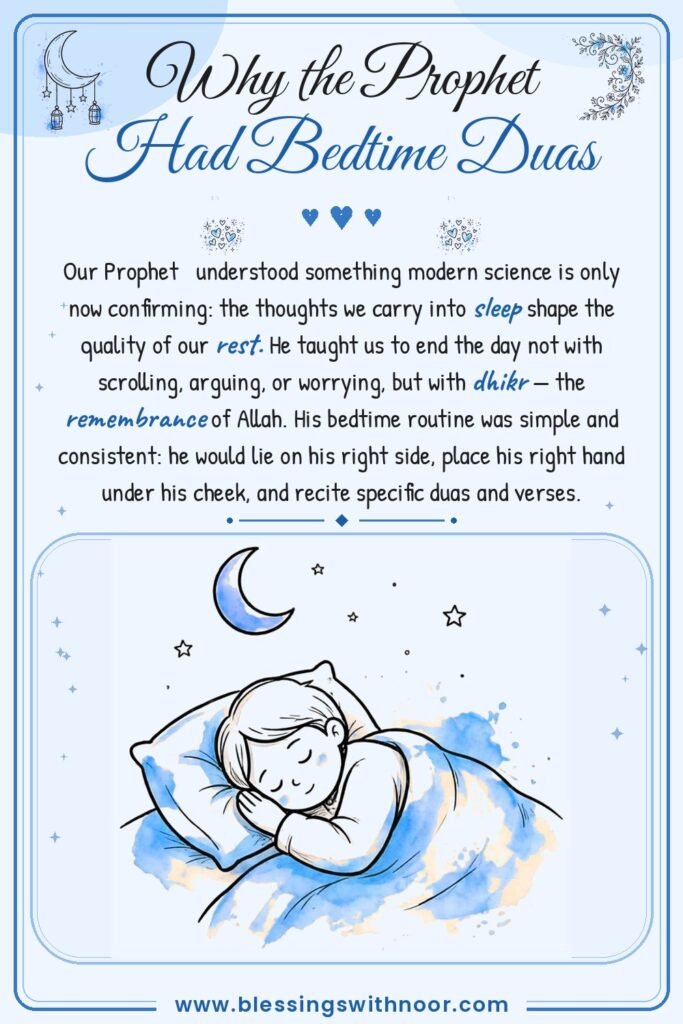
Our Prophet ﷺ understood something modern science is only now confirming: the thoughts we carry into sleep shape the quality of our rest. He taught us to end the day not with scrolling, arguing, or worrying, but with dhikr — the remembrance of Allah. His bedtime routine was simple and consistent: he would lie on his right side, place his right hand under his cheek, and recite specific duas and verses.
This matters because sleep in Islam is a trust. Every night we surrender our souls to Allah, not knowing whether we will wake again. The Quran reminds us that Allah calls us to Him, saying, “Call upon Me; I will respond to you” (Quran 40:60). Bedtime dua is our nightly answer to that call — a moment of honesty before the One who knows our day better than we do. When you make these duas a habit, you will notice a change: nights feel calmer, sleep comes easier, and waking up feels like a gift rather than a chore.
The Essential Sunnah Duas Before Sleeping
Here are the core duas of the Prophet’s ﷺ bedtime routine. Learn them one at a time, starting with the shortest.
1. “In Your Name, O Allah, I Die and I Live”
Arabic: بِاسْمِكَ اللَّهُمَّ أَمُوتُ وَأَحْيَا
Transliteration: Bismika Allahumma amutu wa ahya.
Meaning: “In Your name, O Allah, I die (sleep) and I live (wake).” The Prophet ﷺ said this every night as he lay down. Teach it to your children — it is the first and most precious bedtime dua, reminding us that sleep and waking are both in Allah’s hands.
2. “Protect Me from Your Punishment”
Arabic: اللَّهُمَّ قِنِي عَذَابَكَ يَوْمَ تَبْعَثُ عِبَادَكَ
Transliteration: Allahumma qini ‘adhabaka yawma tab’athu ‘ibadak.
Meaning: “O Allah, protect me from Your punishment on the Day You resurrect Your servants.” Said three times before sleep, this short dua connects our nightly “small death” with the reality of the Last Day, filling the heart with humble hope.
3. “In Your Name I Lie Down and Rise”
Arabic: اللَّهُمَّ بِكَ وَضَعْتُ جَنْبِي، وَبِكَ أَرْفَعُهُ، فَإِنْ أَمْسَكْتَ نَفْسِي فَارْحَمْهَا، وَإِنْ أَرْسَلْتَهَا فَاحْفَظْهَا بِمَا تَحْفَظُ بِهِ عِبَادَكَ الصَّالِحِينَ
Transliteration: Allahumma bika wada’tu janbi, wa bika arfa’uhu, fa in amsakta nafsi farhamha, wa in arsaltaha fahfazha bima tahfazu bihi ‘ibadakas-salihin.
Meaning: “O Allah, in Your name I lie down and in Your name I rise. If You take my soul, have mercy on it; if You return it, guard it as You guard Your righteous servants.” This is the dua for anxious hearts — it hands every outcome of the night to Allah’s mercy.
4. The Dua of Complete Surrender
Arabic: اللَّهُمَّ أَسْلَمْتُ نَفْسِي إِلَيْكَ، وَفَوَّضْتُ أَمْرِي إِلَيْكَ، وَأَلْجَأْتُ ظَهْرِي إِلَيْكَ، رَغْبَةً وَرَهْبَةً إِلَيْكَ، لَا مَلْجَأَ وَلَا مَنْجَا مِنْكَ إِلَّا إِلَيْكَ، آمَنْتُ بِكِتَابِكَ الَّذِي أَنْزَلْتَ، وَبِنَبِيِّكَ الَّذِي أَرْسَلْتَ
Transliteration: Allahumma aslamtu nafsi ilayk, wa fawwadtu amri ilayk, wa alja’tu zahri ilayk, raghbatan wa rahbatan ilayk, la malja’a wa la manja minka illa ilayk, amantu bikitabikalladhi anzalta, wa binabiyyikalladhi arsalta.
Meaning: “O Allah, I surrender myself to You, entrust my affairs to You, and lean upon You, hoping in You and fearing You. There is no refuge from You except in You. I believe in Your Book which You revealed and Your Prophet whom You sent.” The Prophet ﷺ said that whoever says this at night and then dies, dies upon the fitrah — the pure natural faith. It is the crown of bedtime duas.

Verses of Protection for the Night
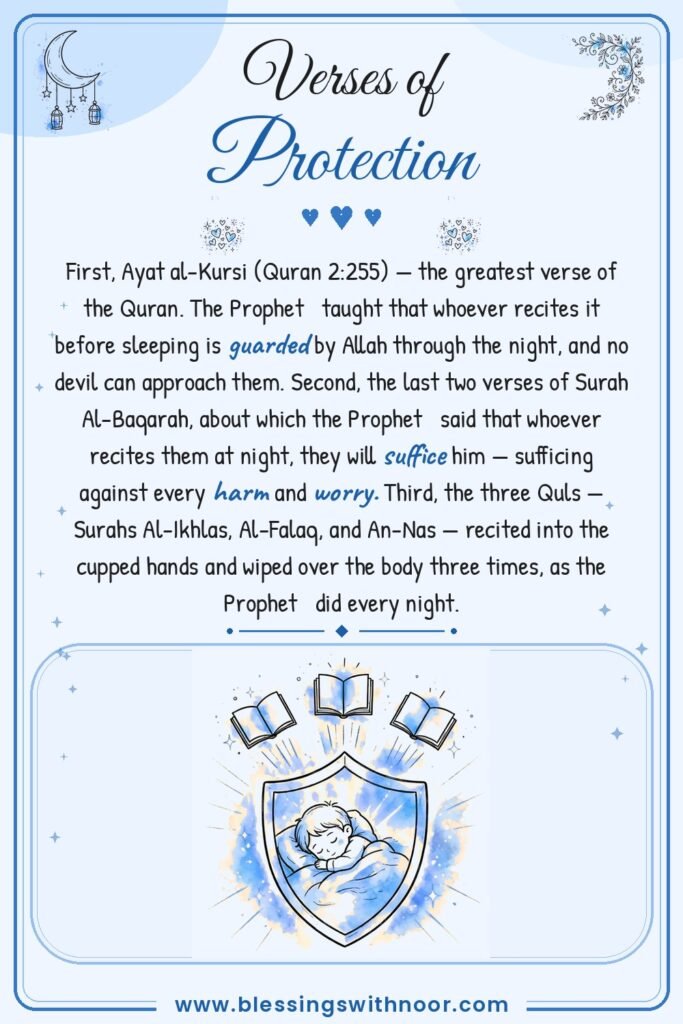
Alongside the duas, the Sunnah prescribes three powerful recitations before sleep. First, Ayat al-Kursi (Quran 2:255) — the greatest verse of the Quran. The Prophet ﷺ taught that whoever recites it before sleeping is guarded by Allah through the night, and no devil can approach them. Second, the last two verses of Surah Al-Baqarah, about which the Prophet ﷺ said that whoever recites them at night, they will suffice him — sufficing against every harm and worry. Third, the three Quls — Surahs Al-Ikhlas, Al-Falaq, and An-Nas — recited into the cupped hands and wiped over the body three times, as the Prophet ﷺ did every night.
These recitations form a spiritual shield around the sleeper. To understand the greatest of them more deeply, see our article on Ayat al-Kursi & Duas for Protection from Evil, and for a broader collection of night blessings visit our Night Prayers category.
When and How to Recite: A Practical Guide
Timing is simple: make these duas the very last thing you do before closing your eyes. Perform wudu first — sleeping in a state of purity brings the angels’ company and deeper rest. Lie on your right side with your right hand beneath your cheek, following the Prophet’s ﷺ example. Then recite Ayat al-Kursi, the last two verses of Al-Baqarah, and the three Quls with the wiping practice. Follow with the duas above, starting with the short ones. If you have children, recite aloud so they hear and learn; bedtime is the most natural classroom for dhikr. And if you wake during the night, even briefly, whisper la ilaha illallah — the night hours are precious, and any remembrance in them is beloved to Allah.

Building the Habit: Tips for the Whole Family
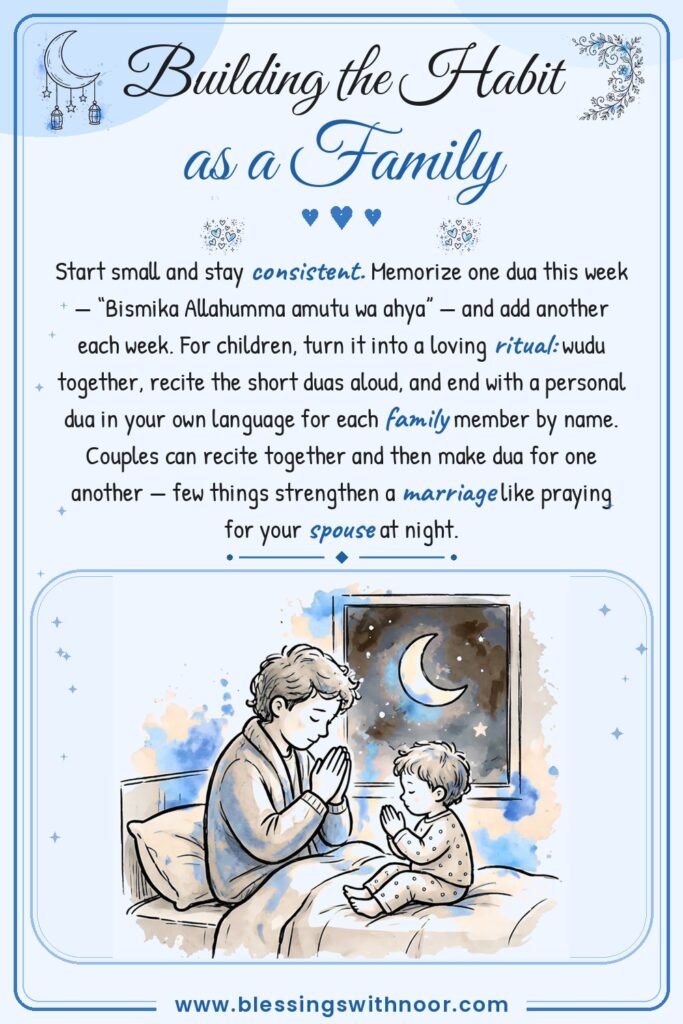
Start small and stay consistent. Memorize one dua this week — “Bismika Allahumma amutu wa ahya” — and add another each week. Place a small dua card on your nightstand until the words live in your heart. For children, turn it into a loving ritual: wudu together, recite the short duas aloud, and end with a personal dua in your own language for each family member by name. Couples can recite together and then make dua for one another — few things strengthen a marriage like praying for your spouse at night. If you sometimes fall asleep before finishing, do not despair; Allah rewards intention, and even a sleepy whisper of His name is precious. Over time, this routine becomes as natural as breathing — and your nights will never feel empty again.
Frequently Asked Questions
Do I need wudu before the bedtime duas?
Wudu is recommended and brings great reward — the Prophet ﷺ encouraged sleeping in a state of purity — but the duas and dhikr themselves can still be said without it. Do what you can; do not abandon the duas because you missed wudu.
What if I forget the Arabic wording?
Say the duas in your own language with a sincere heart. Learn the Arabic gradually; Allah accepts the dua of every tongue. The meaning matters most.
Can children recite these duas?
Yes — in fact, bedtime is the best time to teach them. Start with the short “Bismika Allahumma amutu wa ahya” and Ayat al-Kursi, and watch the habit grow with them.
A Night Dua for You
As you prepare for sleep tonight, know that you are following in the footsteps of the Prophet ﷺ with every word of remembrance. May Allah accept your duas, guard your sleep with His angels, forgive the shortcomings of your day, and wake you in the morning with a heart full of light. May your nights be peaceful, your dreams be sweet, and your waking be blessed. Sleep well — under the watch of the One who never sleeps.