Every marriage needs two wings to fly: mawaddah — deep, tender love — and rahmah — mercy, compassion, and understanding. Love without mercy burns out in the first storm; mercy without love grows cold. But together, they carry a couple through every season of life. And the beautiful secret is this: both are gifts you can ask Allah for, every single day.
In this article, you will find a heartfelt dua for love in marriage — built around the Quran’s own description of the marital bond — with Arabic, transliteration, and translation. You will also discover why understanding matters as much as affection, how mercy heals what love alone cannot, and practical ways to pray these qualities into your marriage.
Mawaddah wa Rahmah: The Quran’s Blueprint for Marriage
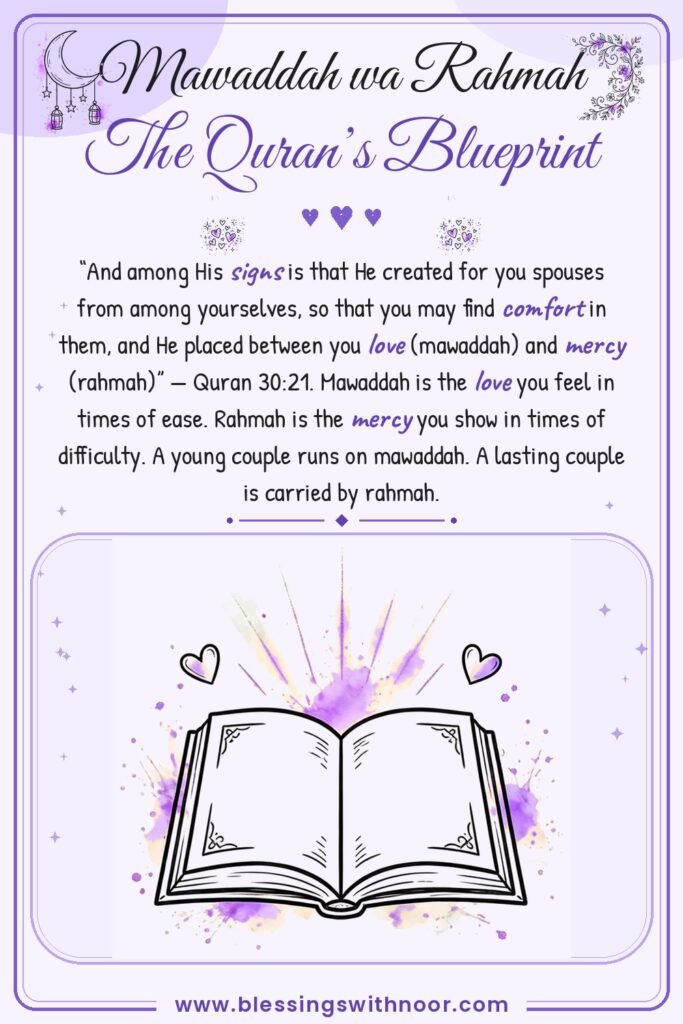
Allah describes the marital bond in one perfect verse: “And among His signs is that He created for you spouses from among yourselves, so that you may find comfort in them, and He placed between you love (mawaddah) and mercy (rahmah)” (Quran 30:21). Scholars explain the difference beautifully: mawaddah is the love you feel in times of ease — the warmth, the attraction, the joy. Rahmah is the mercy you show in times of difficulty — the patience when your spouse is wrong, the gentleness when they are weak, the forgiveness when they fail you.
A young couple runs on mawaddah. A lasting couple is carried by rahmah. When illness comes, when money is tight, when tempers flare — it is mercy that holds the marriage together until love blooms again. This is why your dua for love in marriage should always ask for both: the passion that delights and the compassion that endures.
The Dua for Love, Mercy and Understanding
Here is a comprehensive dua that gathers love, mercy, and understanding into one heartfelt prayer:
اللَّهُمَّ اجْعَلْ بَيْنَنَا مَوَدَّةً وَرَحْمَةً، وَأَلِّفْ بَيْنَ قُلُوبِنَا، وَارْزُقْنَا حُسْنَ التَّفَاهُمِ، وَاصْرِفْ عَنَّا كُلَّ سُوءٍ
Transliteration: Allahummaj’al baynana mawaddatan wa rahmah, wa allif bayna qulubina, warzuqna husnat-tafahum, wasrif ‘anna kulla su’.
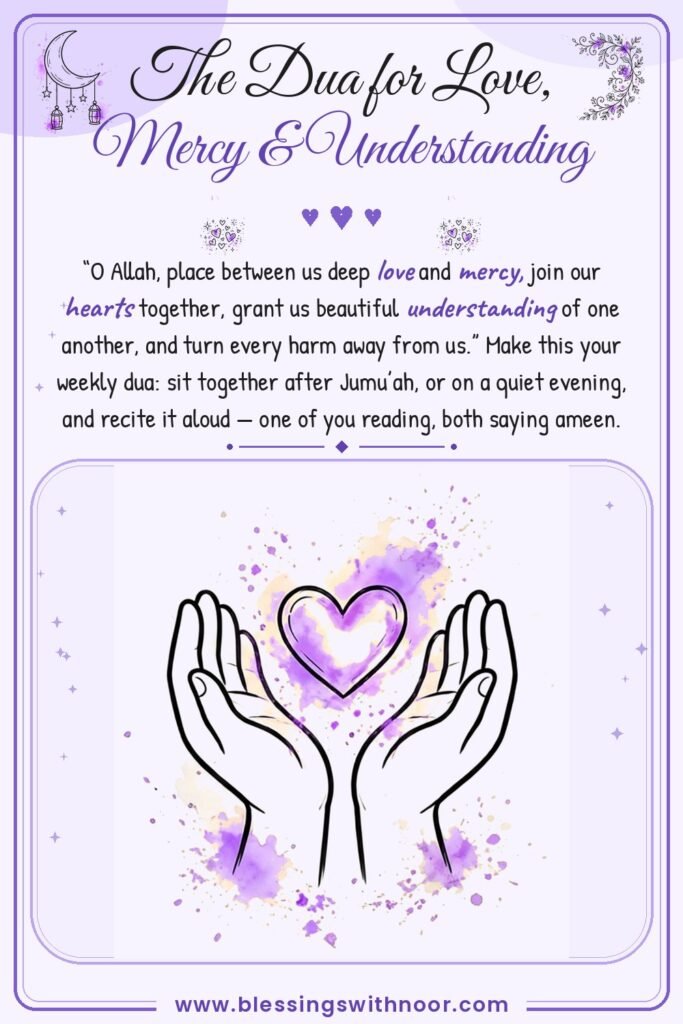
Translation: O Allah, place between us deep love and mercy, join our hearts together, grant us beautiful understanding of one another, and turn every harm away from us.
Notice the third asking — husn at-tafahum, beautiful understanding. So many marital wounds come not from malice but from misunderstanding: words heard wrongly, intentions misread, silence mistaken for coldness. Praying for understanding is praying for the wisdom to see your spouse as they truly are — and to be seen in return. A couple that understands each other rarely needs to fight; they have already won the deeper battle.
Make this your weekly dua: sit together after Jumu’ah, or on a quiet evening, and recite it aloud — one of you reading, both saying ameen. Shared dua is shared vulnerability, and shared vulnerability is the soil in which understanding grows.
When Love Feels Distant: Duas for Hard Seasons
Every marriage passes through winters. If yours feels cold right now, these duas are for you:
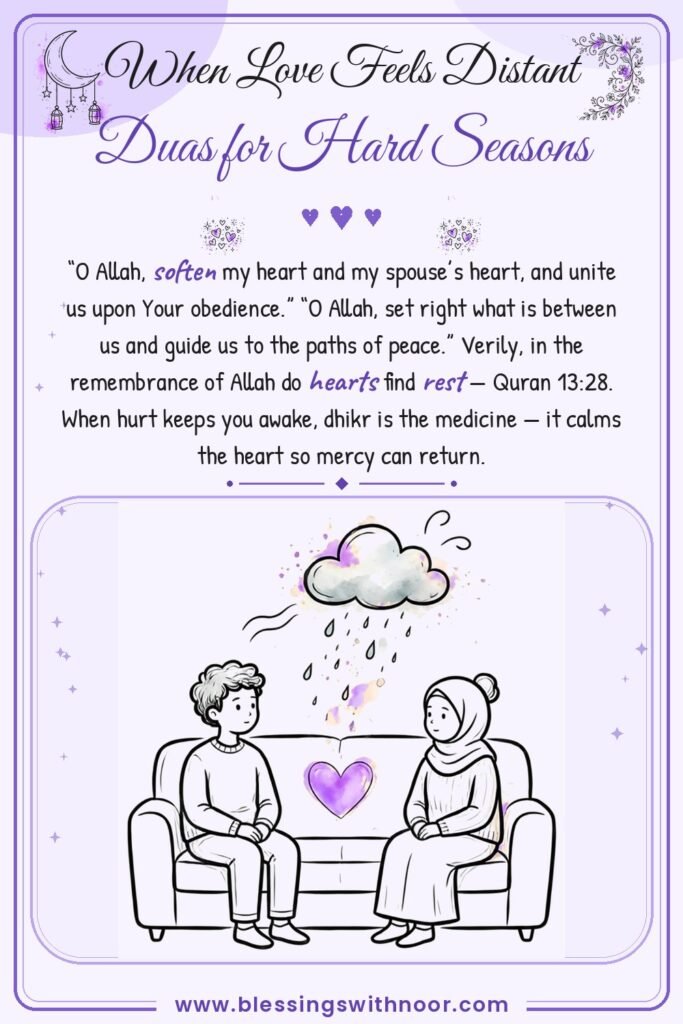
- For softened hearts: اللَّهُمَّ لَيِّنْ قَلْبِي وَقَلْبَ زَوْجِي وَاجْمَعْنَا عَلَى طَاعَتِكَ — Allahumma layyin qalbi wa qalba zawji wajma’na ‘ala ta’atik — “O Allah, soften my heart and my spouse’s heart, and unite us upon Your obedience.” (Wives may say qalba zawjati for “my wife’s heart.”)
- For peace after conflict: اللَّهُمَّ أَصْلِحْ ذَاتَ بَيْنِنَا وَاهْدِنَا سُبُلَ السَّلَامِ — Allahumma aslih dhata baynina wahdina subulas-salam — “O Allah, set right what is between us and guide us to the paths of peace.”
- For a tranquil heart: Remember Allah’s promise: “Verily, in the remembrance of Allah do hearts find rest” (Quran 13:28). When hurt keeps you awake, dhikr is the medicine — it calms the heart so mercy can return.
- For renewed affection: اللَّهُمَّ رُدَّ إِلَيْنَا حُبَّنَا وَأَلِّفْ بَيْنَنَا كَمَا أَلَّفْتَ بَيْنَ قُلُوبِ عِبَادِكَ الصَّالِحِينَ — Allahumma rudda ilayna hubbana wa allif baynana kama allafta bayna qulubi ‘ibadikas-salihin — “O Allah, return our love to us and join us as You joined the hearts of Your righteous servants.”
Practical Ways to Grow Love, Mercy and Understanding
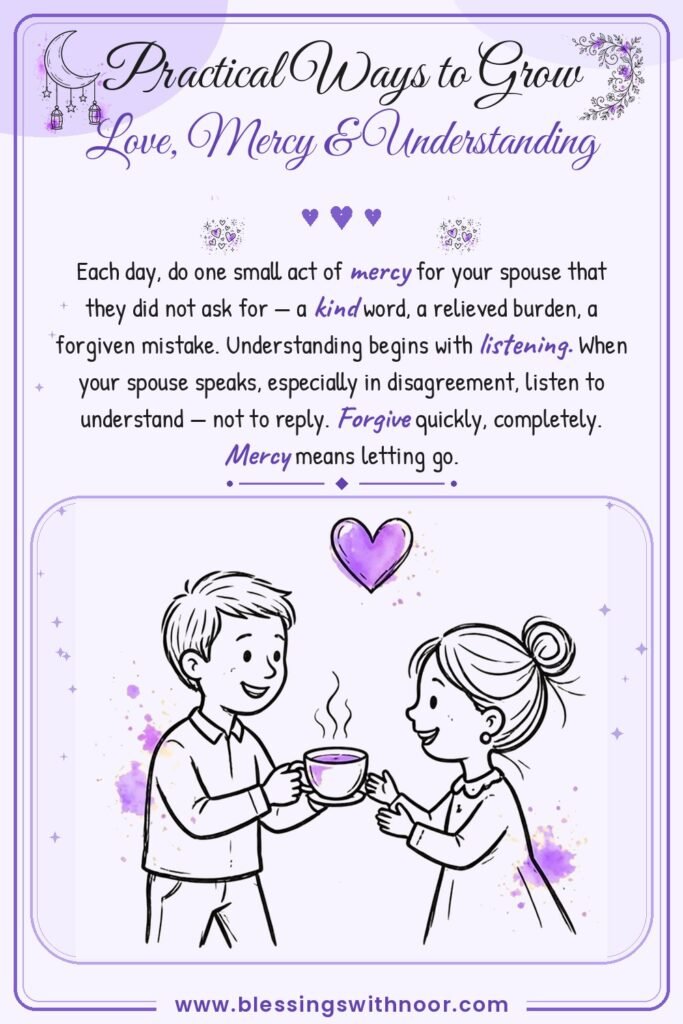
1. The daily mercy habit. Each day, do one small act of mercy for your spouse that they did not ask for — a kind word, a relieved burden, a forgiven mistake. Then make dua: “O Allah, accept this small mercy and place mercy between us.” Action watered by dua grows fastest.
2. Listen before you answer. Understanding begins with listening. When your spouse speaks, especially in disagreement, listen to understand — not to reply. The Prophet (peace be upon him) listened with his full attention, and his marriages were filled with deep mutual understanding.
3. Forgive quickly, completely. Mercy means letting go. Do not keep a ledger of wrongs; it poisons love from the inside. Forgive as you hope Allah forgives you — and then pray for the one who hurt you. Nothing melts resentment like sincere dua for the person you are angry with.
4. Celebrate the milestones. Mark your anniversaries with gratitude and dua — see our wedding anniversary duas for beautiful words for the occasion. And for the foundation of it all, revisit our Islamic duas for love between husband and wife.
Explore more in our Love Blessings collection — every article there is written to help your marriage flourish.
Seeing Through Your Spouse’s Eyes
Understanding is a skill, but it begins as a dua. Before you try to understand your spouse’s words, ask Allah to let you understand their heart. The husband who prays, “O Allah, show me what my wife carries that she cannot say,” will start noticing the tiredness behind her smile. The wife who prays, “O Allah, show me the pressures my husband hides,” will start hearing the worry beneath his silence.
Then practice what you prayed for. When your spouse reacts strongly, pause and wonder instead of judging: what might they be feeling that I cannot see? This single habit — curiosity instead of criticism — dissolves more conflicts than a hundred arguments ever could. Understanding does not mean always agreeing; it means your spouse feels truly known by you. And there is no deeper form of love than being fully known and still fully loved.

Frequently Asked Questions
What is the difference between mawaddah and rahmah?
Mawaddah is active, tender love — the warmth and affection you feel and show. Rahmah is mercy and compassion — the gentleness that carries you through hardship, mistakes, and weakness. A complete marriage needs both, which is why Quran 30:21 mentions them together.
Can dua fix a marriage that feels broken?
Dua is the beginning of every healing, not a magic wand. Pray sincerely, then take the means: communicate honestly, seek counsel from the wise, and show mercy even when it is hard. Allah guides the one who turns to Him — and many “broken” marriages have been rebuilt on sincere dua and patient effort.
How can I be more understanding toward my spouse?
Pray for it first — understanding is a gift from Allah. Then practice it: assume good intentions, ask before concluding, and remember that your spouse fights battles you cannot see. Mercy toward their struggles creates understanding of their heart.
Should couples make dua together or separately?
Both. Pray together to build unity — even briefly, after one prayer a day. And pray secretly for each other, for the angels say ameen to hidden duas. Together you build the bond; in secret you protect it.
A Final Word
Love delights the heart, mercy steadies it, and understanding knits two souls into one. Ask Allah for all three — daily, sincerely, together — and He who placed mawaddah wa rahmah between you will keep renewing them until your last day. May your marriage be a garden where love blooms, mercy flows like water, and understanding grows deeper with every passing year. Ameen.