“Nikah Mubarak!” — two words that carry the weight of a thousand blessings. When two hearts are joined in the sacred bond of marriage, the whole community rejoices, angels witness the union, and Allah Himself places love and mercy between the couple. A nikah is not just a ceremony; it is an act of worship, a completion of half the deen, and the beginning of a journey walked hand in hand toward Jannah.
Whether you are attending a wedding, congratulating a newly married couple, or preparing for your own nikah, knowing the right wedding duas transforms your congratulations from mere words into powerful prayers. This collection gathers the most beloved nikah mubarak duas — including the famous Sunnah wedding dua — with their meanings, when to say them, and how to share them.
The Sunnah Wedding Dua: “Barakallahu Laka”
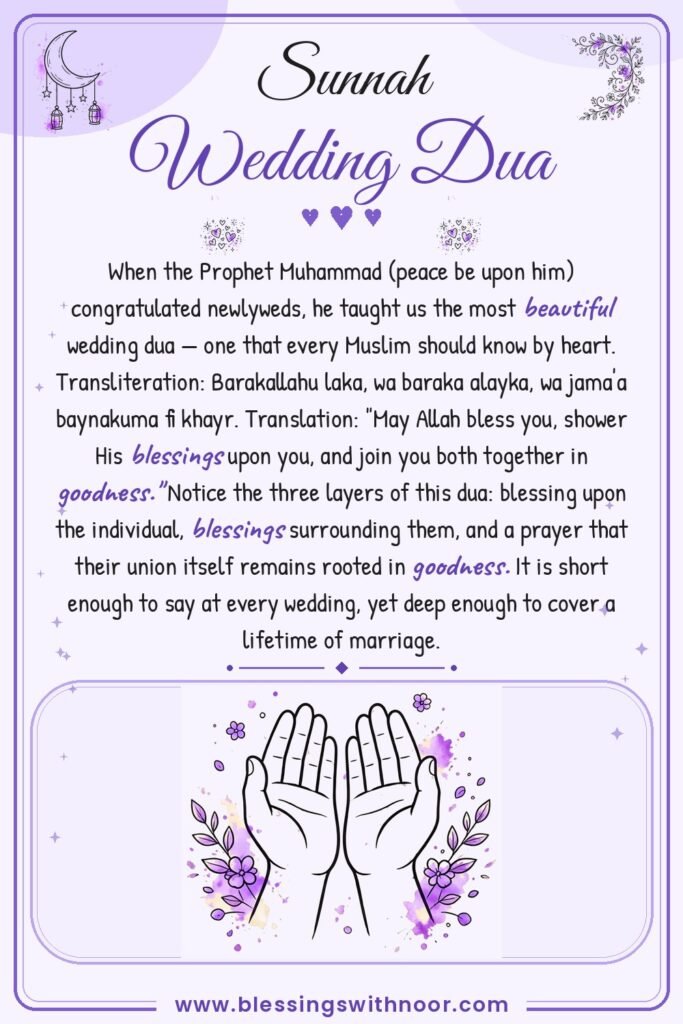
When the Prophet Muhammad (peace be upon him) congratulated newlyweds, he taught us the most beautiful wedding dua — one that every Muslim should know by heart:
Arabic: بَارَكَ اللَّهُ لَكَ وَبَارَكَ عَلَيْكَ وَجَمَعَ بَيْنَكُمَا فِي خَيْرٍ
Transliteration: Bārakallāhu laka, wa bāraka ‘alayka, wa jama’a baynakumā fī khayr
Translation: “May Allah bless you, shower His blessings upon you, and join you both together in goodness.”
Notice the three layers of this dua: blessing upon the individual, blessings surrounding them, and a prayer that their union itself remains rooted in goodness. It is short enough to say at every wedding, yet deep enough to cover a lifetime of marriage. Make it your default congratulation — say it to the groom, to the bride, to their families. You can also write it in wedding cards: “Barakallahu laka wa baraka alayka wa jama’a baynakuma fi khayr — Nikah Mubarak!”
The Prophet (peace be upon him) also made dua for couples in his own words, asking Allah to bless their union and grant them righteous offspring. Following his example, add your own heartfelt words after the Sunnah dua.
The Quranic Vision of Marriage: Love and Mercy
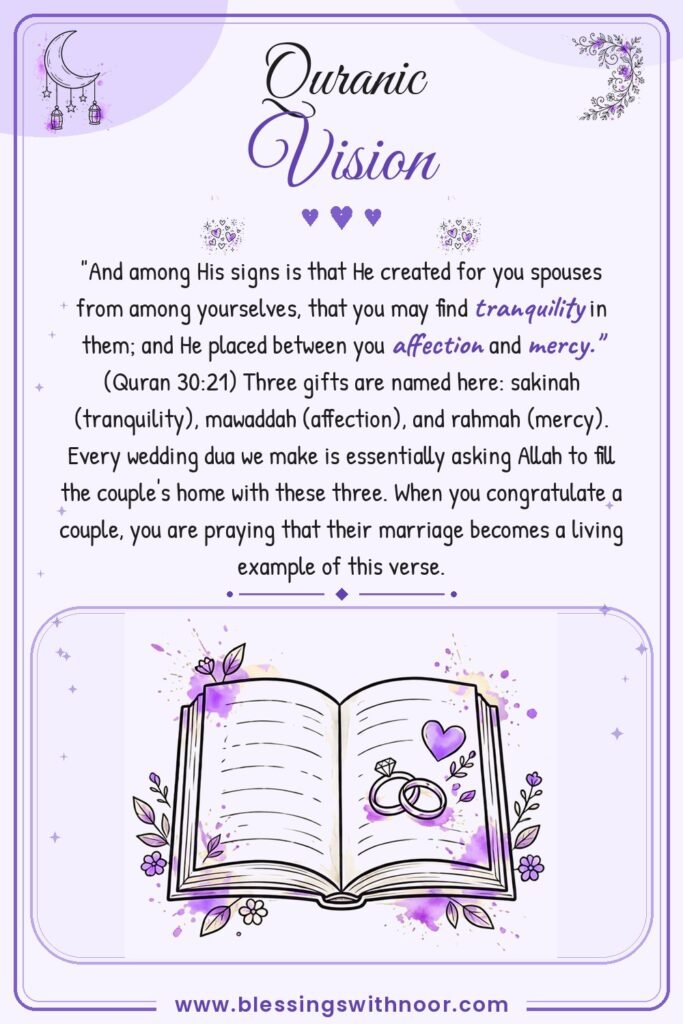
Before we shower couples with blessings, let us understand what marriage is in Islam. Allah describes it in one of the most beautiful verses of the Quran:
Three gifts are named here: sakinah (tranquility), mawaddah (affection), and rahmah (mercy). Every wedding dua we make is essentially asking Allah to fill the couple’s home with these three. When you congratulate a couple, you are praying that their marriage becomes a living example of this verse.
Another beautiful verse to share with newlyweds is the dua of the righteous: “Our Lord, grant us from our spouses and offspring comfort to our eyes, and make us leaders of the righteous.” (Quran 25:74) — a prayer couples can recite together throughout their marriage.
What Actually Happens at a Nikah — and Why the Words Matter
Many guests hear “Nikah Mubarak” all day without ever stopping to think about what has actually taken place in the room. A nikah is, at its heart, a contract — but in Islam a contract of a very particular kind. It is made in the presence of witnesses, it includes the mahr agreed for the bride, and it is spoken aloud so that the marriage is public, honoured, and protected. Nothing about it is casual or hidden. That public, witnessed nature is itself a blessing: two people are not slipping into a relationship, they are being entrusted to each other in front of their families and, above all, before Allah.
That is why the language of the day matters so much. When the contract is agreed, the couple’s relationship changes in the sight of Allah — what was not permissible becomes a source of reward, companionship, and tranquility. Families who understand this tend to feel the ceremony differently. The signing is not paperwork before the party. It is the moment the marriage actually begins, and many people quietly make dua at exactly that moment, sensing that prayers made while witnessing a righteous beginning carry a special sincerity.
It also helps to understand what “Mubarak” is really wishing for. Barakah is not just happiness, and it is more than a smooth first year. It is increase that comes from Allah — love that deepens instead of fading, provision that suffices even when it looks small, patience that appears in the very argument you thought would divide you. When you say “Nikah Mubarak,” you are asking Him to place that unseen increase over everything the couple will build: their home, their time, their future children, and their worship together.
For a broader look at praying over a marriage at every stage, see our complete guide to marriage blessings.
It is also worth noticing how the nikah balances joy with responsibility. The same gathering that celebrates the couple also hears, in the contract and the khutbah, reminders about kindness, fairness, and the rights each spouse holds over the other. Marriage in Islam is worship, but it is not only private devotion — it creates duties toward a real person, in real daily matters like provision, patience, listening, and forgiveness. That is why duas for a couple so often ask for character, not just chemistry. Love brings two people to the contract; mercy, honesty, and steadiness are what will carry them through the ordinary Tuesdays of married life, long after the wedding clothes are packed away and the photographs fade into an album.
So choose your congratulations with a little intention. Say the Sunnah dua first, because it was taught for exactly this moment. Then add one personal line that fits this couple — something you have noticed about their kindness, their faith, or their families. A dua that could only have been written for them will be remembered long after generic messages are scrolled past.
Beautiful Nikah Mubarak Duas: Messages & Wishes
Here are heartfelt messages to send the happy couple, each carrying the spirit of dua:
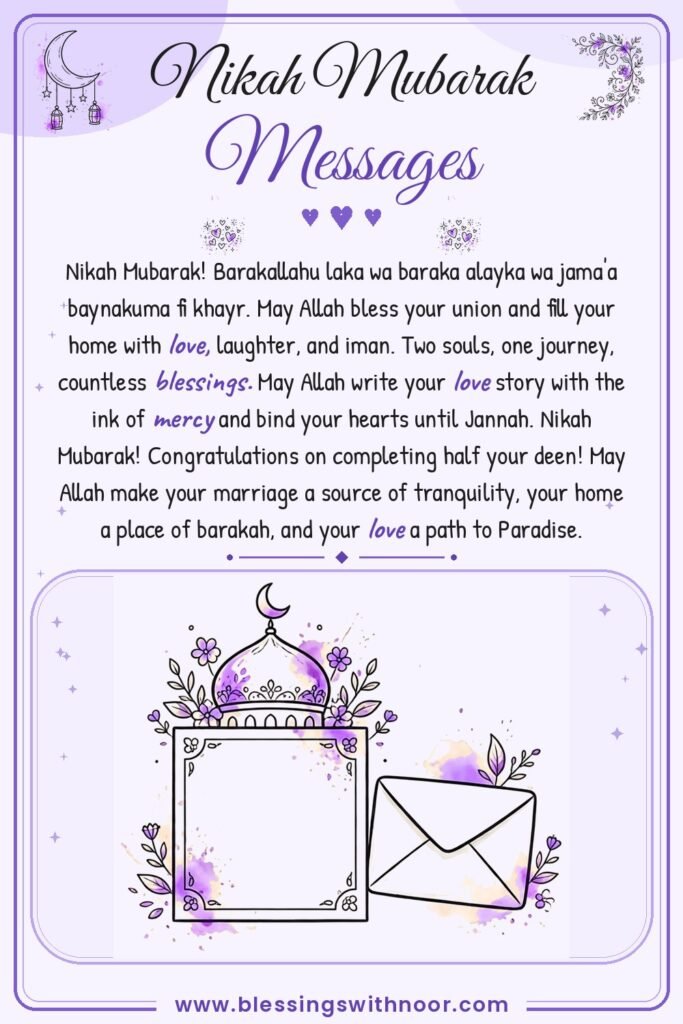
1. Nikah Mubarak! Barakallahu laka wa baraka alayka wa jama’a baynakuma fi khayr. May Allah bless your union and fill your home with love, laughter, and iman.
2. Two souls, one journey, countless blessings. May Allah write your love story with the ink of mercy and bind your hearts until Jannah. Nikah Mubarak!
3. Congratulations on completing half your deen! May Allah make your marriage a source of tranquility, your home a place of barakah, and your love a path to Paradise.
4. Nikah Mubarak to the beautiful couple! May Allah bless you with righteous children, abundant rizq, and a love that grows deeper with every passing year.
5. As you begin this blessed journey together, my dua is that Allah grants you the love of Khadijah and the Prophet (peace be upon them) — loyal, deep, and eternal.
6. May your nikah be the beginning of endless happiness. May Allah protect your marriage from the evil eye and surround you both with His mercy. Ameen.
7. Nikah Mubarak! May every morning of your married life begin with gratitude and every night end with contentment. Barakallahu feekuma!
If you are preparing words in a more general style for mixed gatherings, our wedding blessings for newlyweds offer warm options anyone can appreciate.
Duas for the Couple’s New Life Together
Beyond congratulations, here are deeper duas to pray for the couple — in your sujood, after prayers, or quietly at the wedding:
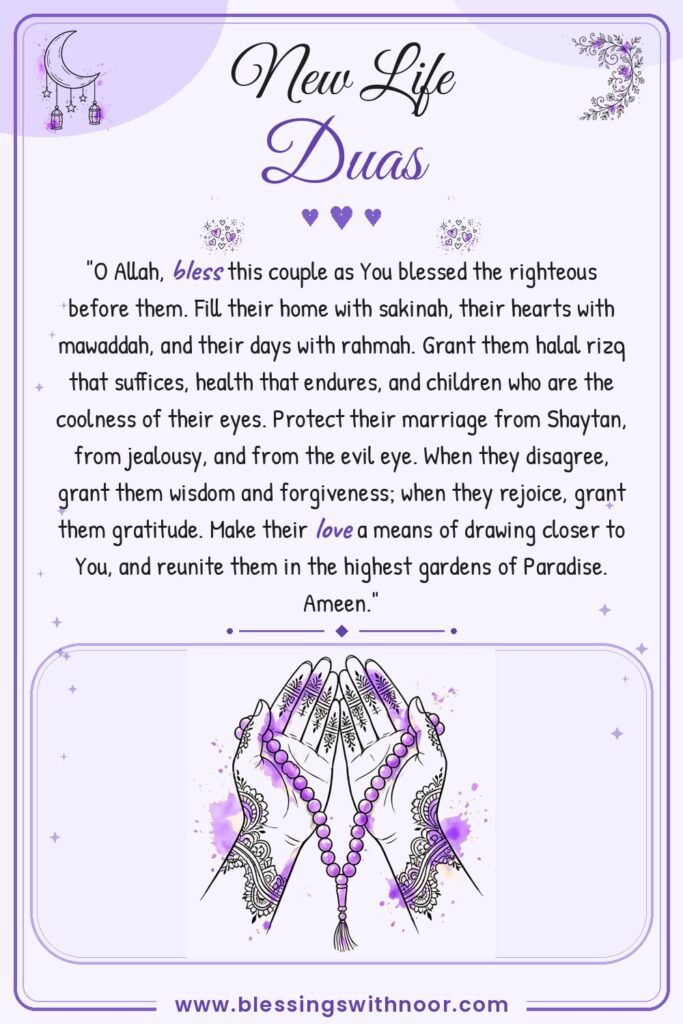
“O Allah, bless this couple as You blessed the righteous before them. Fill their home with sakinah, their hearts with mawaddah, and their days with rahmah. Grant them halal rizq that suffices, health that endures, and children who are the coolness of their eyes. Protect their marriage from Shaytan, from jealousy, and from the evil eye. When they disagree, grant them wisdom and forgiveness; when they rejoice, grant them gratitude. Make their love a means of drawing closer to You, and reunite them in the highest gardens of Paradise. Ameen.”
Guests at a wedding should remember: your presence is a gift, but your dua is the greater gift. While others bring envelopes, bring sincere prayers — they last longer than any present.
What to Do (and Say) at a Nikah Ceremony
If you are attending a nikah, here is a simple, beautiful etiquette:
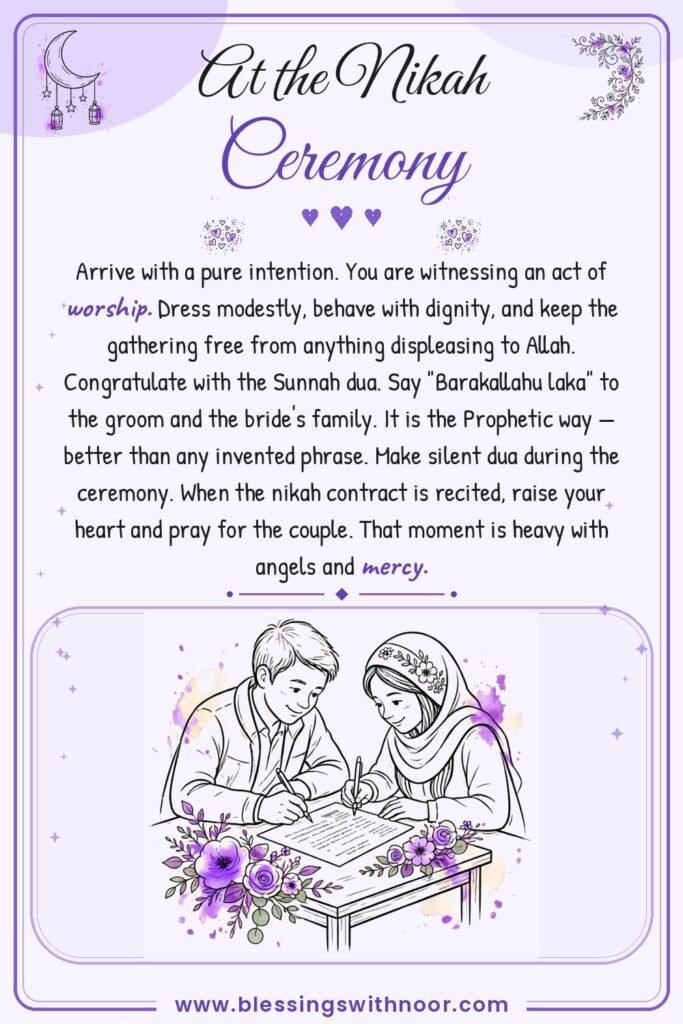
Arrive with a pure intention. You are witnessing an act of worship. Dress modestly, behave with dignity, and keep the gathering free from anything displeasing to Allah.
Congratulate with the Sunnah dua. Say “Barakallahu laka…” to the groom and the bride’s family. It is the Prophetic way — better than any invented phrase.
Make silent dua during the ceremony. When the nikah contract is recited, raise your heart (if not your hands) and pray for the couple. That moment is heavy with angels and mercy.
Share in the walima joyfully. Attending the wedding feast is a Sunnah and a right of the couple over the community. Eat, smile, and make the couple feel loved.
Follow up after the wedding. A message a week later — “How is married life? Making dua for you both” — means more than you know. Newlyweds need ongoing prayers, not just wedding-day wishes.
For duas specific to the bride, read our Wedding Dua for the Bride, and for the groom, our Wedding Blessings for the Groom.
And for the celebrations that come before the contract is signed, these engagement blessings and duas help you congratulate the couple at the very start of their journey.
How to Share a Nikah Mubarak Message Well
If you are attending in person, your warmest moment is usually just after the contract, when you congratulate the groom, the bride’s family, and later the bride herself as custom in your family allows. Keep it brief in that moment — the Sunnah dua, a smile, and one kind sentence. The couple will greet dozens of people, and a calm, sincere blessing stands out more than a long speech in a crowded line.
For words written especially for her, share one of these heartfelt wedding duas for the bride on the morning of the ceremony.
For a message or card, write it so it can be kept. Start with “Nikah Mubarak,” include the Arabic dua or its transliteration if the couple would appreciate it, and then write one or two lines in your own words. If you are messaging, send it on the day itself rather than days later, and consider a second, quieter message a week or two afterwards when the guests have gone home and real married life has started — that follow-up is often the one couples mention months later.
If you cannot attend, say so honestly and let your dua travel in your place. A short voice note, a gift sent with your written dua inside the card, or praying for the couple during the ceremony from wherever you are all honour the day properly. What matters is not how grand the gesture is, but whether the couple can feel that their marriage was witnessed, celebrated, and genuinely prayed for.
To keep praying for them beyond the wedding day, browse these duas for a newly married couple for their first weeks and months together.
Frequently Asked Questions
What does “Nikah Mubarak” mean?
It means “Blessed Nikah” — a congratulation wishing Allah’s blessings upon the marriage. It is the Islamic equivalent of saying “Congratulations on your wedding,” with dua built in.
Is the “Barakallahu laka” dua obligatory to say?
It is a recommended Sunnah, not obligatory — but it is the most beloved and authentic way to congratulate newlyweds, taught by the Prophet (peace be upon him) himself.
Can I say Nikah Mubarak to the bride directly?
Yes, with modesty and through appropriate channels — in a card, in a family gathering, or via her mahram relatives. The dua is for both spouses equally.
Conclusion: Celebrate with Prayer
A nikah is heaven touching earth for a moment — two people, one covenant, witnessed by Allah and His angels. The greatest way to honor it is not with extravagance but with sincerity: a heartfelt “Barakallahu laka,” a silent dua from the heart, and a lifetime of wishing the couple well.
So the next time you hear of a nikah, do not just send a generic congratulations. Pause, raise your hands, and pray for the couple as the Prophet (peace be upon him) taught us. Your dua might be the one that protects their marriage for decades to come. Nikah Mubarak to every couple beginning this blessed journey — may Allah fill your union with love, mercy, and endless barakah. Ameen.
Discover more wedding blessings in our Wedding duas collection.